

Sequoia Just Put Supply Chain on the Map. Here's What That Actually Means.
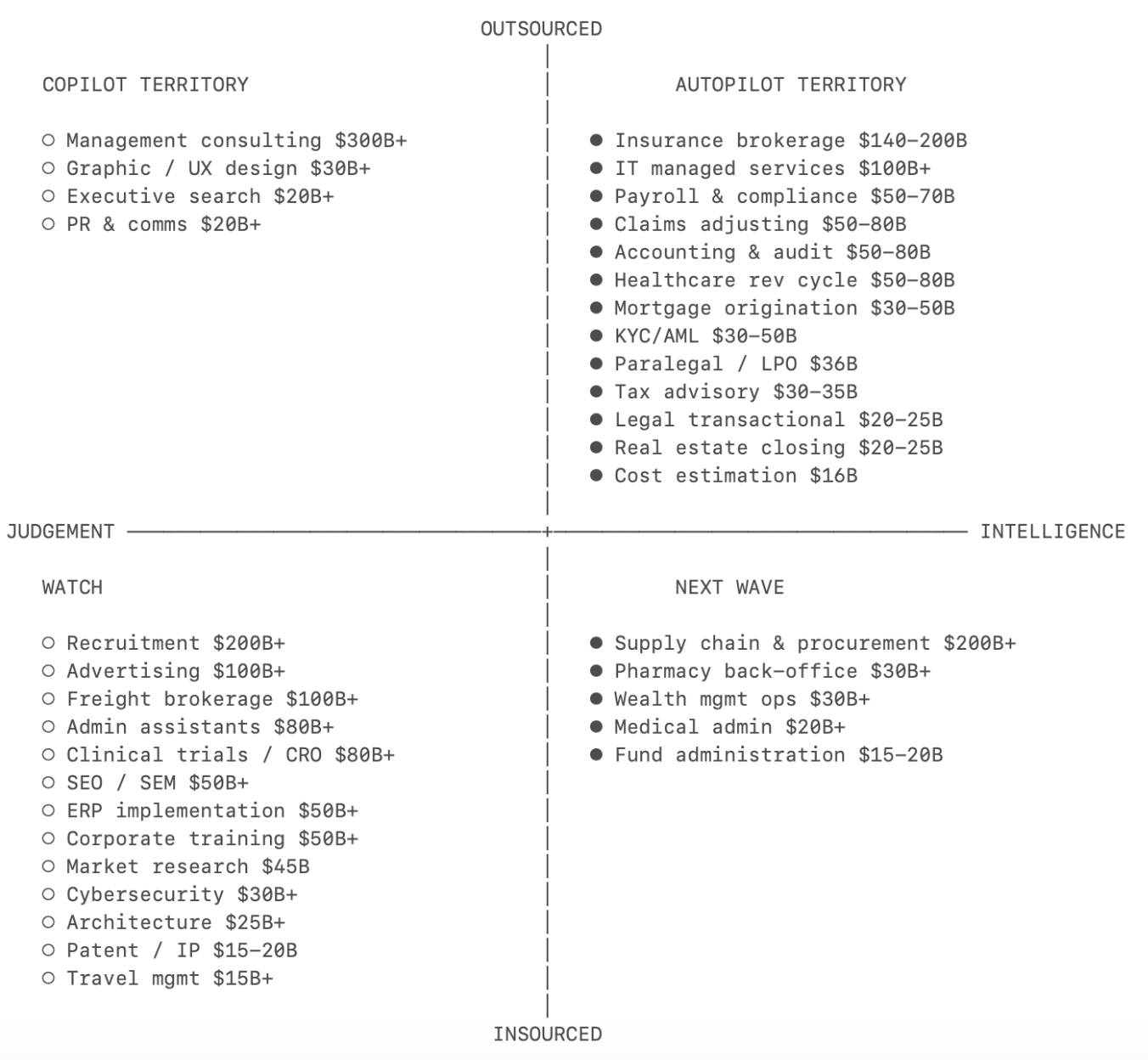
Last week, Sequoia — the firm behind Apple, Google, and Airbnb — released a market map that broke the internet. It plotted industries across two axes: outsourced vs. insourced, and judgement vs. intelligence.
Supply chain and procurement landed in the bottom-right quadrant. They called it "Next Wave." At $200 billion plus.
I've been sitting with that framing all week, because I think most people are misreading what it means.
First, what the map is actually saying
The four quadrants tell a story about how AI will move through industries:
Copilot (outsourced + judgement): AI assists humans in knowledge work. Think management consulting, UX design, PR.
Autopilot (outsourced + intelligence): AI fully executes tasks, no human in the loop. Insurance underwriting, paralegal work, accounting.
Watch (insourced + judgement): AI is entering, but humans still call the shots. Recruitment, advertising, admin assistants.
Next Wave (insourced + intelligence): The frontier. AI lives inside the organization and becomes the reasoning engine. Supply chain. Pharmacy back-office. Wealth management ops.
"Next Wave" doesn't mean it's coming eventually. It means the infrastructure is forming now — and the window to lead is open.
Why supply chain specifically?
Supply chain operations are, at their core, an information problem.
Every day, procurement teams are processing signals — supplier delays, price fluctuations, demand shifts, contract terms, shipping exceptions — across hundreds of email threads, spreadsheets, portals, and PDFs. The information exists. The capacity to synthesize it, in real time, at scale, doesn't.
That's the gap AI closes.
And here's what makes supply chain different from, say, legal or accounting: the decisions are time-sensitive and cascading. A missed signal from a supplier doesn't just affect one invoice — it ripples through production timelines, customer commitments, and cash flow. The cost of slow intelligence is high. Which is exactly why the upside of fast intelligence is enormous.
What "insourced" means and why it matters
Look at the Autopilot quadrant. Those are outsourced use cases — work that gets handed off to an AI-powered service provider. Think AI-powered accounting firms or legal process outsourcers.
Supply chain sits in the insourced half. That's deliberate.
Procurement intelligence can't live outside the organization. It requires access to your contracts, your supplier relationships, your internal systems, your communication history. The competitive advantage is that context. You don't outsource it. You build the intelligence layer on top of it.
This is why the companies winning in this space aren't building another SaaS dashboard. They're building the layer that reads your existing data environment and makes it intelligent — without requiring you to change how you operate.
The $200B number
Let's be honest about what that figure represents. It's not revenue already captured. It's the market opportunity created by the gap between how supply chain operations work today and how they could work with genuine AI intelligence embedded in them.
Most enterprise procurement teams are still running on a combination of an ERP, an inbox, and institutional knowledge that walks out the door when people leave. The inefficiency is structural. The $200B is the cost of that inefficiency — and the opportunity for whoever closes it.
What supply chain leaders should be doing right now
Stop waiting for your ERP vendor. The legacy systems are building AI features, but they're building them on top of architecture that was never designed for real-time intelligence. The most interesting solutions are being built around the edges of those systems, not inside them.
Audit where your intelligence actually lives. For most teams, it's in email. Supplier updates, pricing negotiations, exception handling — it's all in the inbox. That's your data layer. Figure out who's building on top of it.
Think about the interface, not just the automation. The temptation is to automate tasks. The bigger opportunity is to redesign how your team interacts with information — moving from reactive inbox management to proactive intelligence surfacing.
Move before the consolidation happens. Every VC-backed market map creates a land grab. The companies that establish intelligence infrastructure now will be significantly harder to displace in three years.
Sequoia didn't call supply chain the largest Next Wave opportunity by accident. They're seeing deal flow. They're seeing what's being built.
The question isn't whether AI transforms supply chain operations. The question is whether your organization is positioned to lead that transformation or respond to it.
The map is out. The window is open.